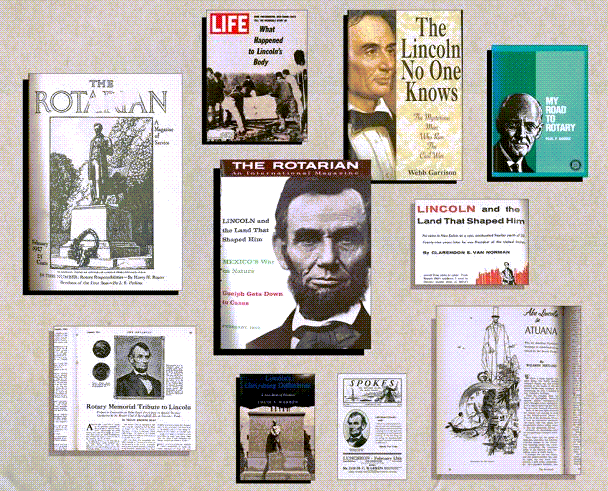
On 20 July 1916, during an unexpected lull on the final day of the seventh Rotary Convention, the Boston editor and publisher Joe Mitchell Chapple rose to deliver an impromptu speech to the hundreds of hot and restless delegates crammed inside the sweltering Emery Auditorium in Cincinnati. He began by ladling praise on Rotary’s president, Allen D. Albert, “whose genius has made this convention a sweet and inspiring memory.”
Turning his attention to another president, Chapple then made this anachronistic pronouncement: “In reviewing history … I believe the first great Rotarian of this country was Abraham Lincoln.”
Given that Lincoln died in 1865, 40 years before Paul Harris founded Rotary, even Chapple had to admit that historical fact undercut the validity of his remark. But its larger truth could not be denied. When “Lincoln mingled among his fellowmen,” insisted Chapple, he related to them “in true Rotarian style.” And so, “as the hour approaches for the close of this splendid convention,” Chapple urged his fellow Rotarians to return home and “reconsecrate ourselves to the ideals inspired by Lincoln,” a challenge met by warm applause.
Chapple may have been on to something, the kind of truth that Thomas Jefferson, one of Lincoln’s philosophical forefathers, would have called self-evident. Though nowhere in Rotary’s founding documents is Lincoln enshrined as a guiding spirit, there are plenty of examples that he was regarded as one. Growing up in Vermont, Paul Harris was told that “there never has been and there never will be another Abraham Lincoln,” the kind of remark that sticks with a child. And in My Road to Rotary, his late-in-life memoir, Harris wrote that the Gettysburg Address, initially regarded as a failure, eventually “became recognized at home and abroad as the greatest speech ever made in the English language” — an implicit acknowledgment of Lincoln’s unparalleled oratorical skills from Rotary’s master communicator.
Harris’ admiration for Lincoln was shared across Rotary. In February 1929, this magazine (known then, as it was for most of its 115 years, as The Rotarian) noted that “the anniversary of the birth of Abraham Lincoln — February 12th — will be observed by Rotary Clubs throughout the United States by special programs stressing the principles of life and government for which the immortal Emancipator fought and suffered.”
One of those programs occurred in Manhattan in 1930. In its newsletter, Spokes, the Rotary Club of New York announced that Louis Warren would be the guest speaker at its luncheon at the Commodore hotel on 13 February. The director of the Lincoln Historical Research Foundation in Fort Wayne, Indiana, Warren later boasted that he had addressed more than 170 Rotary clubs, speaking most often about the Gettysburg Address.
Nowhere was Rotary’s regard for Lincoln more evident than in the pages of The Rotarian. His image adorned the magazine’s cover on at least two occasions. In February 1927, the cover featured a moody rendering of the Augustus Saint-Gaudens statue known as the “Standing Lincoln” that presides over Chicago’s Lincoln Park. Thirty-six years later, in February 1963, the magazine showcased what it called (inexactly) “the sad and brooding countenance” of Lincoln as captured by the photographer Alexander Gardner 11 days before the president delivered his Gettysburg Address — which, insisted the editors, remained “one of the greatest of human utterances.”
This is only part of the story. This story originally appeared in the February 2026 issue of Rotary magazine. You can read the entire story here.